Abstract: Use less component count, money, and board space when designing Sallen-Key filters. Simplify band pass filters with fixed gain amplfiers.
Simple second-order filters meet many filtering requirements. A low-order low-pass filter, for example, is often adequate for anTIaliasing in ADC applicaTIons or for eliminaTIng high-frequency noise in audio applicaTIons. Similarly, a low-order high-pass filter can easily remove power-supply noise. When you design such filters with built-in gain, fixed-gain op amps can save space, cost, and time. Figure 1 illustrates the use of fixed-gain op amps in building second-order low-pass and high-pass Sallen-Key filters. Filter "cookbooks" are useful in designing these filters, but the cookbook procedures usually break down for a given response, such as Butterworth, if the gain set by RF and RG is greater than unity. What's more, the cookbook component-value formulas can yield unrealistic values for the capacitors and the resistors.
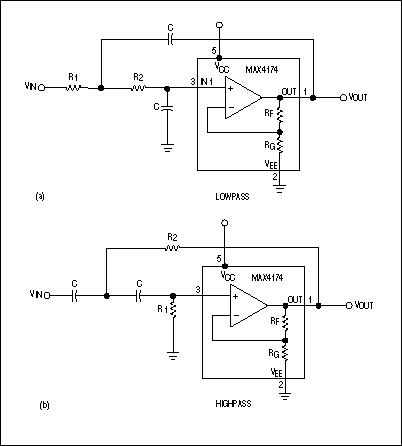
Figure 1. Sallen-Key filters use fixed-gain op amps to realize a second-order Butterworth response.
Butterworth filters, for example, offer the flattest passband. They also provide a fast initial falloff and reasonable overshoot. You can easily design such filters using the table below with the following equations: R2 = 1/(2πfC √) and R1 = XR2.
Butterworth-Filter-Design Criteria
|
Gain
|
Low-Pass X
|
High-Pass X
|
|
1.25
|
*
|
1.372
|
|
1.5
|
2
|
1.072
|
|
2
|
0.5
|
0.764
|
|
2.25
|
0.404
|
0.672
|
|
2.5
|
0.343
|
0.602
|
|
3
|
0.268
|
0.5
|
|
3.5
|
0.222
|
0.429
|
|
4
|
0.191
|
0.377
|
|
5
|
0.15
|
0.305
|
|
6
|
0.125
|
0.257
|
|
7
|
0.107
|
0.222
|
|
9
|
0.084
|
0.176
|
|
10
|
0.076
|
0.159
|
|
11
|
0.07
|
0.146
|
|
13.5
|
0.057
|
0.121
|
|
16
|
0.049
|
0.103
|
|
21
|
0.038
|
0.08
|
|
25
|
0.032
|
0.068
|
|
26
|
0.031
|
0.066
|
|
31
|
0.026
|
0.056
|
|
41
|
0.02
|
0.043
|
|
50
|
0.017
|
0.035
|
|
51
|
0.017
|
0.035
|
|
61
|
0.014
|
0.029
|
|
81
|
0.011
|
0.022
|
|
100
|
0.009
|
0.018
|
|
101
|
0.009
|
0.018
|
*A gain of 1.25 is impossible to obtain with matched capacitors for the low-pass case.
For a gained filter response, the use of a fixed-gain op amp reduces cost and component count. It also decreases sensitivity, because the internal, factory-trimmed, precision gain-setting resistors provide 0.1% gain accuracy. To design a second-order Butterworth low-pass or high-pass filter using a fixed-gain op amp, follow these steps:
- Determine the corner frequency fC.
- Select a value for C.
- For the desired gain value, locate X under the proper column heading in the table.
- Calculate R1 and R2 using the equations.
Choosing C and then solving for R1 and R2 lets you optimize the filter response by selecting component values as close to the calculated values as possible. C can be lower than 1000pF for most corner frequencies and gains. Fixed-gain op amps come optimally compensated for each gain version and provide exceptional gain-bandwidth products for systems operating at high frequencies and high gain. Suppose, for example, you must design a low-pass filter with a 24kHz corner frequency and a gain of 10. Step 1 is complete (fC = 24kHz). Next, complete Step 2 by selecting a value for C, say, 470pF. In the table, note that X = 0.076 for a low-pass filter with a gain of 10. Substitute these values in the equations:
R2 = 1/(2π fC √) = 1/(2π × 24kHz × 470pF × √ ) = 51kΩ, and R1 = XR2 = 0.076 × 51kΩ = 3.9kΩ.
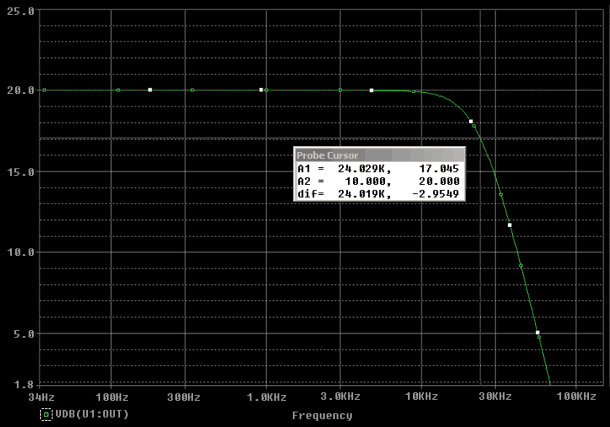
Figure 2. Using the circuit values in the text, a simulation of the circuit in Figure 1a produces this Butterworth response.
A similar version of this article appeared in the July 6, 2000 issue of EDN.